Cement has a carbon problem that no amount of efficiency can fully solve.
Roughly half of its carbon dioxide emissions arise not from burning fuel, but from the chemical decomposition of limestone during clinker production. It is an inescapable consequence of the manufacturing process itself. Global cement manufacturing produces approximately 1.6 billion metric tonnes of CO₂ annually, accounting for roughly 8 percent of total worldwide emissions.
For years, the conversation about decarbonising cement has focused on Europe and North America. Africa’s producers were barely visible in the policy conversation—underfunded, under-scrutinised, and frequently absolved of ambition on the grounds of development imperatives.
Bamburi Cement is pushing back against that assumption.
The Deal That Changes Everything
In December 2025, Bamburi Cement signed a $250 million (KSh 32 billion) Engineering, Procurement and Construction contract with China’s Sinoma CBMI Construction Co. Ltd.
The project? A 1.6 million-tonnes-per-year clinker production plant in Matuga, Kwale County. At 5,000 tonnes per day, the facility is one of the country’s largest industrial investments in recent years.
President William Ruto witnessed the signing, describing it as a major step in Kenya’s industrialisation journey. The plant will more than double Bamburi’s clinker capacity and reduce Kenya’s dependence on imported clinker.
Construction began in the first quarter of 2026, with the first clinker expected by early 2028. At the height of construction, the project is projected to create more than 10,000 direct and indirect jobs, injecting fresh economic activity into Kwale County and the wider coastal region.
Not Your Father’s Cement Plant
What makes this deal significant is not just the scale. It is the technology.
The new facility will deploy modern production technology, integrating alternative fuel systems, solar power, and locally sourced raw materials. These features place the project firmly within Bamburi’s decarbonisation roadmap and align with Kenya’s broader push for green, climate-smart industrial growth.
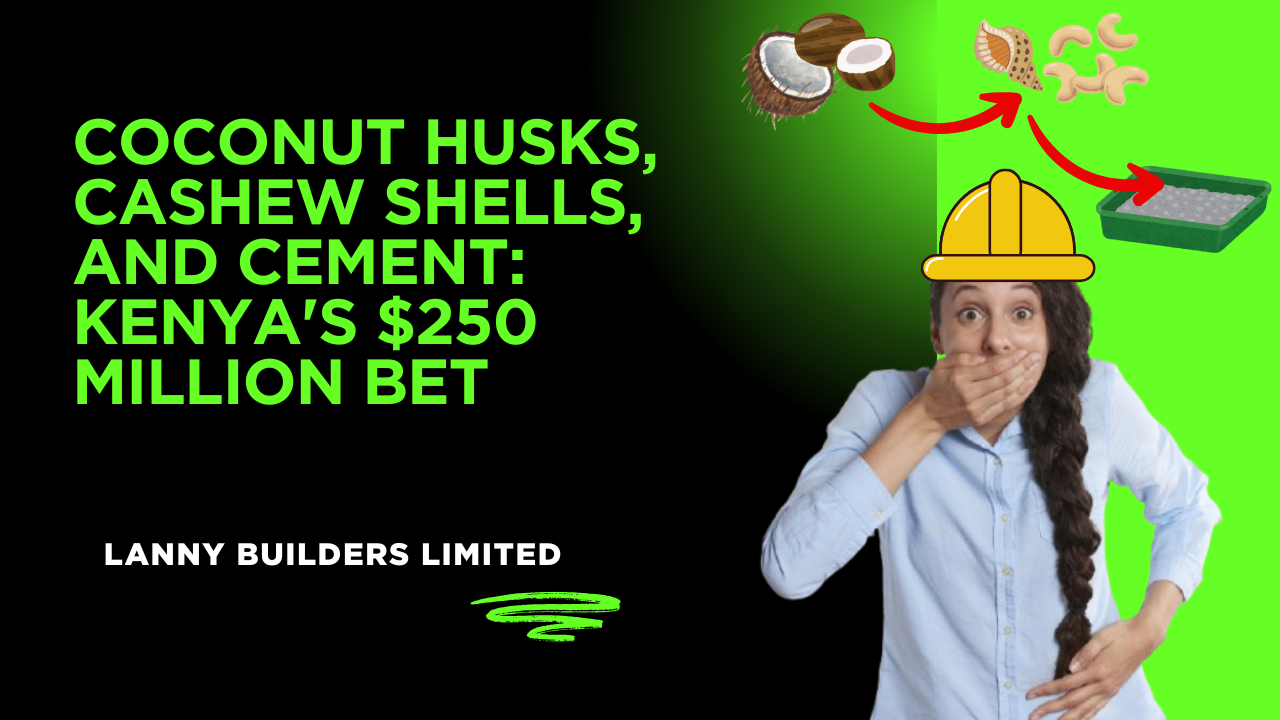
The plant will use a six-stage pre-calciner system and incorporate emissions-reduction technologies, including the use of alternative fuels such as coconut husks, cashew shells, and municipal solid waste.
Bamburi CEO Mohit Kapoor has described the Kwale plant as central to the company’s strategy to modernise its asset base and reduce exposure to imported raw materials.
The Fuel Substitution Story
The Kwale plant is the headline. But the more immediate measure of Bamburi’s decarbonisation credentials lies in its alternative fuels programme, which has been running for over a decade.
The company has substituted heavy fossil fuels with biomass, including rice husks, as well as waste tyres and waste oil. By 2024, it had achieved a 98 percent alternative fuel substitution rate at its Nairobi grinding plant—a record for its Kenyan operations.
That figure is striking by global benchmarks. The average alternative fuel substitution rate across the European cement industry, the most advanced in this respect, remains below 60 percent.
The savings are not solely environmental. Jane Wangari, Sustainability and Geocycle Director at Bamburi Cement, has observed that biomass costs bear no comparison to heavy fuel oil:
“The use of alternative fuels is not only saving the carbon emissions but also saving us money because the cost of biomass, frankly speaking, you cannot equate it to the price of heavy fuel oil”.
Beyond Bamburi: The LC3 Revolution
While Bamburi builds its mega-plant, a quieter revolution is happening in laboratories across Kenya.
The United Nations Industrial Development Organization (UNIDO) has been promoting Limestone Calcined Clay Cement (LC3) , a low-carbon cement that blends clinker with limestone and calcined clay—both available in Kenya.
LC3 was invented by the Swiss Federal Institute of Technology in Lausanne and developed by a global team with support from the Swiss Agency for Development and Cooperation.
The numbers are compelling. LC3 allows up to 60 percent of clinker content in cement to be replaced without compromising strength or durability. This can cut cement manufacturing CO₂ emissions by up to 40 percent.
Crucially, LC3 can be produced with only minimal modifications to existing production lines, making it a cost-effective and scalable solution for cement producers in Kenya.
The lab at Meru University of Science and Technology’s Institute of Cement and Concrete is dedicated to testing and analysing LC3 materials. Tomasz Pawelec from UNIDO’s Net Zero Partnership for Industrial Decarbonization described the visit:
“It was fascinating to see that you don’t need huge labs or expensive machinery to produce low-carbon cement using materials that are literally under our feet”.

The Clinker Import Levy Controversy
The Bamburi–Sinoma deal sits against a backdrop of fierce debate over Kenya’s clinker import levy.
In July 2023, the government introduced a 17.5 percent levy on clinker imports. The impact was immediate. Clinker imports fell from 148,000 tonnes in 2023 to just 10,300 tonnes in 2024. Cement production declined by 7.9 percent, while consumption dropped by 7.2 percent. Exports to Uganda and Tanzania dropped significantly by 49.6 percent.
Trade Cabinet Secretary Lee Kinyanjui has argued that Kenya lacks the internal capacity to manufacture clinker and that the levy is hurting local companies, raising production costs and making them uncompetitive regionally.
President Ruto has taken the opposite view. At the signing of the Bamburi–Sinoma deal, he said:
“We have limestone, we have all other raw materials that are necessary for the production of cement here in Kenya. Somebody needs to explain to me why we want to go and import stones”.
The contradiction between the two positions reflects a deeper tension: the government wants to protect local industry, but the infrastructure to replace imports is still two years away.
The Industry at a Crossroads
Demand for cement in Kenya is expected to rise by 7–8 percent annually as the economy expands and the government presses ahead with its ambitious Affordable Housing Programme, which aims to build one million new homes.
This creates an unmissable opportunity for producers to invest in low-carbon production and reap financial as well as market benefits.
Tomasz Pawelec from UNIDO puts it plainly:
“Low carbon production processes are cheaper to install and run than expansion of traditional systems. Using these processes will also set companies up to seize new market opportunities as low-carbon cements become the norm”.
He adds that boosting cement production does not always require building entirely new facilities:
“It’s totally viable to increase cement production by using smaller-scale solutions, like adding clay-based inputs, rather than building entirely new facilities. This approach allows companies to produce more cement with less clinker, reduce emissions, and avoid huge upfront costs”.
To help local cement producers explore low-carbon solutions, UNIDO’s Net Zero Partnership, in collaboration with the Kenya Association of Manufacturers, will launch a call for expressions of interest, inviting producers to propose ideas for developing low-carbon cement production processes.
What This Means for Builders
For contractors and builders, the shift toward low-carbon cement has practical implications.
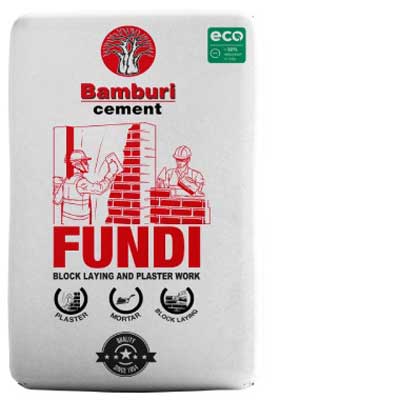
First, green cement is becoming available. Bamburi already offers lower-carbon products including Duracem, Powermax, and Fundi. As LC3 production scales, more options will enter the market.
Second, costs may not be higher. LC3 can be produced with minimal modifications to existing production lines, meaning the cost premium over ordinary Portland cement should be modest—and possibly negative as alternative fuels reduce energy costs.
Third, regulatory pressure is building. The Kenya National Building and Construction Decarbonization Roadmap will eventually require lower-carbon materials. Builders who adopt green cement early will be ahead of compliance curves.
Fourth, client demand is growing. Developers of affordable housing, commercial buildings, and infrastructure projects are increasingly asked about their carbon footprint. Being able to specify lower-carbon cement is a competitive advantage.
Fifth, supply will become more stable. The Bamburi–Sinoma plant will produce 1.6 million tonnes of clinker annually, reducing Kenya’s dependence on imports. That should stabilise prices and reduce the risk of supply disruptions.
The Bottom Line
The Bamburi–Sinoma pact is not just about one company building one plant. It is about the direction of an entire industry.
Kenya’s cement sector is at a crossroads. Demand is rising. The pressure to decarbonise is mounting. The technology to produce lower-carbon cement is available and affordable.
Bamburi is betting big on alternative fuels, solar power, and local clinker production. The UNIDO is promoting LC3 as a scalable, low-cost solution. The government is caught between protecting local industry and acknowledging that capacity is still two years away.
For builders, the message is clear: the cement you use in five years will not be the cement you use today. It will have a lower carbon footprint. It may cost less to produce. And it will be made in Kenya, from Kenyan materials.
The question is whether you will be ready to specify it.
| Key Data Point | Detail |
|---|---|
| Contract value | $250 million (KSh 32 billion) |
| Parties | Bamburi Cement & Sinoma CBMI Construction Co. Ltd |
| Location | Matuga, Kwale County |
| Capacity | 1.6 million tonnes clinker per year (5,000 tonnes/day) |
| Construction start | Q1 2026 |
| First clinker expected | Early 2028 |
| Jobs created | 10,000+ direct and indirect |
| Alternative fuels used | Coconut husks, cashew shells, municipal solid waste |
| Bamburi’s alternative fuel substitution rate (Nairobi plant) | 98% |
| European industry average | Below 60% |
| Global cement CO₂ emissions | 1.6 billion tonnes annually (8% of total) |
| Clinker import levy | 17.5% (introduced July 2023) |
| Clinker imports (2023 → 2024) | 148,000 → 10,300 tonnes |
| Cement production decline | 7.9% |
| LC3 clinker replacement | Up to 60% |
| LC3 emission reduction | Up to 40% |
| Cement demand growth forecast | 7-8% annually |
| Affordable Housing Programme target | 1 million new homes |