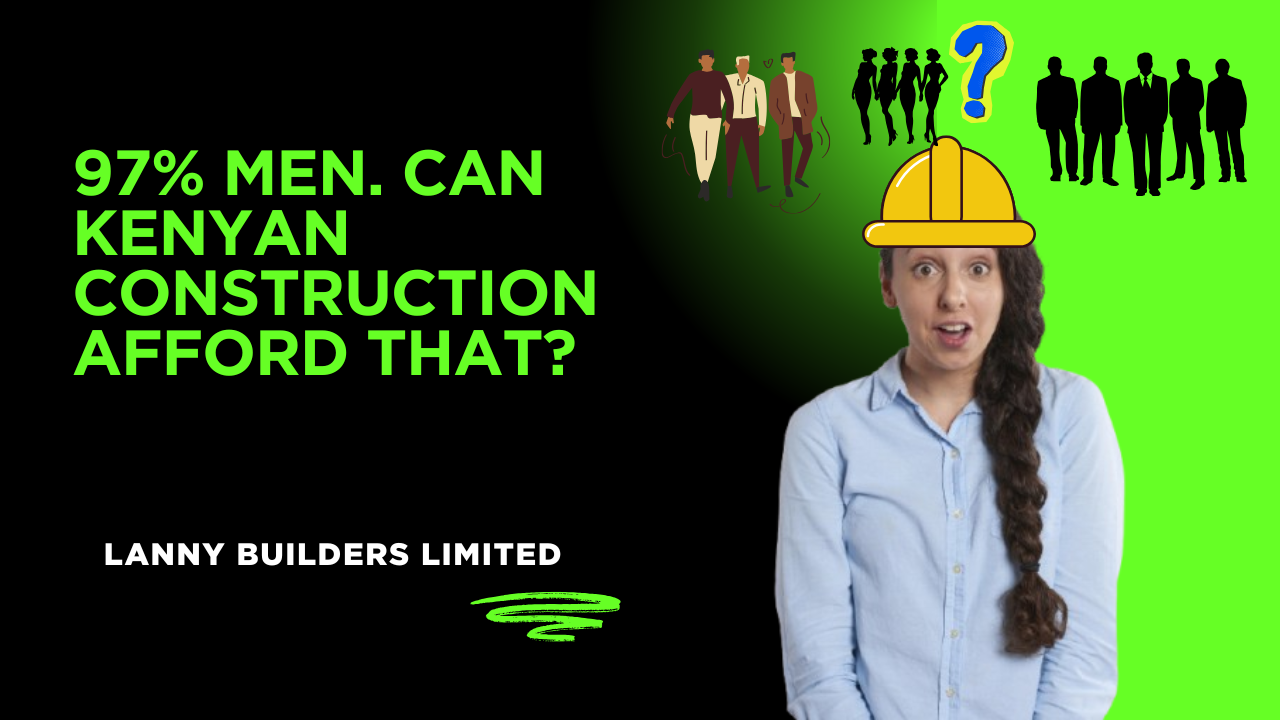
IMost construction sites in Kenya something have something in common. The workers are nearly all men. The foremen are men. The site managers are men. The engineers signing off on structural drawings are overwhelmingly men.
This is not accidental. It is the result of decades of unexamined practice. But it is becoming a problem the industry can no longer afford to ignore.
Women represent less than 3 percent of Kenya’s construction workforce according to the National Construction Authority . At the same time, 55 percent of women are excluded from formal financial services . These two numbers are connected, and they point to a structural issue that costs the industry far more than most builders realise.

The Numbers That Should Stop You
Three percent is not a small gap. It is a near-total exclusion.
In a country where the construction sector contributes significantly to GDP and the government is building over 200,000 homes annually under the Affordable Housing Programme, leaving out half the population from the workforce is not just unjust. It is inefficient.
The Global Buildings Performance Network (GBPN) put it plainly in February 2026 when they launched the “Building Fair Futures” initiative in partnership with the National Construction Authority, State Department of Public Works, Women in Real Estate (WiRE), and the Architectural Association of Kenya . The initiative’s goal is to ensure the construction sector is not only decarbonized, but also democratized .
Democratized. That is the word they chose. Because a sector that excludes half the population cannot claim to be building for everyone.
Why This Matters Now
There are three reasons 2026 is the year this conversation becomes urgent.
First, the labour shortage is real. The Affordable Housing Programme alone needs tens of thousands of skilled workers. With the current workforce structure, the industry cannot meet demand. Opening the pipeline to women is not charity. It is filling seats.
Second, the quality of work improves with diversity. Studies across multiple industries show that diverse teams produce better outcomes. Different perspectives catch blind spots. Different approaches solve problems faster. In construction, where safety and precision matter, diversity is not a soft metric. It is a performance metric.
Third, the financing environment is shifting. The 55 percent of women excluded from formal financial services represent a massive untapped market for housing finance. If women cannot access mortgages, they cannot buy the homes being built. If they cannot buy, the market shrinks. The same financial institutions funding construction projects are increasingly aware of this.
What “Building Fair Futures” Actually Does
The initiative launched in February 2026 introduces two practical tools that move beyond talk.
The first is the Justice, Equity, Diversity and Inclusion (JEDI) Toolkit . This is a practical guide for construction firms to assess their own practices. It asks hard questions. Are your hiring practices excluding qualified women? Are your sites safe for women workers? Do your training programmes reach women? Are your promotion pathways fair?
The second is the She Builds Sustainably Training programme . This is not a one-off workshop. It is a structured skills programme designed to bring women into the construction workforce at scale. It covers technical skills, safety, site management, and the soft skills needed to navigate what remains a male-dominated environment .
Eva Muraya, Founder and CEO of BSD Group and a leading voice in the sector, framed it directly at the launch:
“The question is no longer whether women should be included in sustainable construction. It is how quickly we can remove the barriers that keep them out” .

The Barriers That Keep Women Out
Let us be specific about what those barriers look like.
| Barrier | What It Looks Like | What It Costs the Industry |
|---|---|---|
| Site culture | Construction sites can be hostile environments for women. Harassment, exclusion, and assumptions about capability are common. | Loss of talent. Women who enter the industry often leave within years, sometimes months. |
| Safety infrastructure | Many sites lack separate changing facilities or toilets for women. This may seem minor, but it makes daily work impossible for women who need basic dignity. | Women simply do not apply for roles where basic needs cannot be met. The pipeline dries up before it starts. |
| Training access | Vocational training programmes often have low female enrolment. When women do enrol, they are steered toward interior finishes rather than structural trades. | The industry reinforces its own gender segregation, then complains it cannot find women for roles that require structural skills. |
| Financial exclusion | Women-owned businesses struggle to access credit for equipment, bonding, and working capital. This blocks them from bidding on contracts. | The supply chain loses potentially competitive suppliers. Fewer bids mean higher costs. |
| Mentorship absence | Young women entering construction rarely see women in leadership. Without role models, they struggle to imagine a long-term career. | High turnover. Wasted training investment. |
None of these barriers require massive infrastructure spending to solve. They require attention and intention.
What This Means for Builders
For construction firms reading this, the question is not whether you support inclusion. The question is what you are doing about it.
Are your sites safe for women? Not just legally compliant, but genuinely welcoming. Do you have separate facilities? Do you have a clear policy on harassment? Do your site managers understand they are responsible for culture, not just concrete?
Are your hiring practices intentional? Do you actively recruit women? Do you assume they cannot do certain jobs, or do you test capability fairly? The women who have broken into construction have done so despite the system, not because of it. What would happen if the system worked for them?
Are you accessing the talent pool? The She Builds Sustainably programme will produce trained women ready to work. Will you hire them? Will you give them the same opportunities for advancement you give men? Will you pay them equally?
Are you bidding for contracts that include women? Some government and donor-funded projects now include clauses requiring contractors to employ a minimum percentage of women. If you cannot meet those clauses, you will lose tenders. It is that simple.
The Economic Case
Let us move past ethics for a moment and talk about money.
Kenya needs to build 200,000 homes annually with climate-resilient designs . That is the Affordable Housing Programme target. Meeting it requires every skilled worker the industry can find. Excluding half the population from that workforce makes the target harder to reach, not easier.
At the same time, the 55 percent of women excluded from formal financial services represent a massive housing market . If women cannot get mortgages, they cannot buy the homes being built. Developers who ignore this are leaving money on the table. Financiers who ignore it are missing a growth market.
The government’s own Bottom-Up Economic Transformation Agenda prioritises economic inclusion. Construction is one of the sectors where inclusion translates directly into output.
What Is Already Happening
Change is not waiting for consensus. Some firms have already started.
Women in Real Estate (WiRE), one of the partners in the Building Fair Futures initiative, has been working to increase female participation in property and construction for years. Their network includes women architects, engineers, quantity surveyors, developers, and contractors. They provide mentorship, business development support, and advocacy.
The National Construction Authority has begun tracking gender disaggregated data on its registrations. This matters because what gets measured gets managed. When the regulator starts asking about women in the workforce, contractors start thinking about it.
The Affordable Housing Programme itself includes provisions for local employment that, when implemented well, can benefit women. Some developers have taken this seriously, training and hiring women for roles traditionally held by men. The results have been positive where tried.
The Road Ahead
No one is pretending the shift will happen overnight. Three percent to something approaching parity is a long journey. But it starts with acknowledging that three percent is not a fact of nature. It is a result of choices the industry has made, consciously or unconsciously, for decades.
Those choices can be unmade.
The barriers are known. The solutions are available. The JEDI Toolkit exists. The She Builds Sustainably programme exists. The networks exist. What is needed now is contractors willing to try, willing to learn, willing to adjust.
Eva Muraya’s question hangs in the air: how quickly can we remove the barriers?
For some firms, the answer will be slowly. For others, it will be faster. The firms that move faster will have access to talent their competitors cannot reach. They will win tenders their competitors cannot bid on. They will build reputations their competitors cannot match.
The 2026 Reality
The construction industry in 2026 faces enough challenges without creating its own. Labour shortages. Material costs. Regulatory complexity. Tight margins.
Leaving out half the workforce is a self-inflicted wound. It makes every other problem harder to solve.
The good news is that the solution is in the industry’s hands. Hire differently. Train differently. Manage sites differently. Measure progress.
Three percent is not a ceiling. It is a starting point.